How the NRL Win Totals Market Actually Works

The NRL win totals market is often misinterpreted because it revolves around probabilities rather than concrete predictions about team performance. Teams have ceilings and floors influenced by various factors such as injuries and timing, creating a range of possible outcomes. The market struggles with pricing due to this inherent volatility; it often defaults to conservative estimates. Emphasizing median outcomes over averages provides a more accurate picture. The key takeaway is understanding win totals as probability assessments rather than definitive forecasts, thereby rewarding patient analysis.
- NRL win totals focus on probabilities, not predictions.
- Team volatility affects win totals, highlighting ceilings and floors.
- Median outcomes offer better insights than averages in win totals.
How the NRL Win Totals Market Actually Works
How the NRL Win Totals Market Actually Works
The NRL win totals market doesn’t fail because bookmakers misunderstand teams. It fails because pricing an entire season means making assumptions about how stable, fragile, or volatile a team really is.
Most teams don’t have one season outcome. They have a range. Some live inside tight guardrails. Others can swing wildly depending on health, timing, and how close games fall. Win totals sit right in the middle of that tension, which is why they’re one of the hardest futures markets to price properly.
Understanding win totals starts with understanding range, not predictions.
That framework is applied directly to the 2026 season in our breakdown of where the NRL 2026 win totals market is most exposed, highlighting the teams where range and pricing are most misaligned.
Why Win Totals Are Not Ladder Predictions
A season-long win total isn’t a statement about where a team will finish. It’s a probability question. How often does this team finish above or below a certain number of wins across all realistic versions of the season.
That distinction matters because NRL seasons are short, violent, and fragile. A handful of injuries, a tough scheduling patch, or a poor run in close games can swing a season by three or four wins. That is often the difference between finals and the bottom third of the ladder.
Trying to collapse that reality into a single expected outcome misses the point. The market has to land on one number, but the season itself never does.
Ceiling, Floor, and Volatility
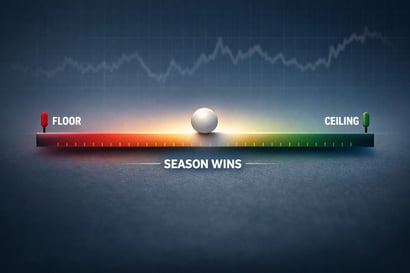
Every team enters the season with a ceiling and a floor.
The floor represents what a bad version of the season looks like. Injuries cluster, combinations struggle, and close games fall the wrong way. The ceiling represents what happens when things click. Key players stay healthy, roles are clear, and a few tight results go their way.
The distance between those two outcomes is volatility.
Some teams are stable. Their ceiling is capped, but their floor is protected. Others are volatile by design. They rely on spine health, younger combinations, or high-variance styles of play. When it works, they surge quickly. When it doesn’t, seasons can unravel just as fast.
Two teams can look very similar on paper and behave very differently over 27 rounds.
Why the Market Struggles With Range
Bookmakers are very good at pricing team strength. They are less perfect at pricing how fragile or explosive that strength is over a long season.
The market is forced to choose a single line. If a team’s realistic outcomes sit between 10 and 15 wins, the book still has to post 12.5 and move on. That’s where assumptions creep in.
Teams with visible downside are often priced conservatively, even when their ceiling remains very much in play. Teams with stable reputations can be priced confidently, even when their margin for error is thin. The result is that some win totals quietly reflect a team’s floor more than its true range.
That is not a mistake. It is a structural limitation of the market.
Why Median Matters More Than Averages
When people talk about expected wins, they often picture a clean middle outcome. In reality, season outcomes are rarely symmetrical.
For volatile teams, extreme outcomes pull the average around. The median tells a more honest story. It shows where the season lands most often, not where it lands once everything is smoothed out.
Win totals are influenced by this difference. A team with a wide distribution can have an average that looks modest while still clearing an over more often than the odds imply. That is why focusing on median outcomes and ranges tends to be more useful than chasing a single expected number.
Win Totals Are About Disagreement, Not Certainty
Strong win total positions rarely come from being confident about how good a team is. They come from disagreement between how the market is pricing a number and how often the team realistically finishes on one side of it.
A Tier 1 position does not imply certainty. It reflects a meaningful gap between the implied probability in the odds and the probability suggested by a full-season distribution. The edge is probabilistic, not predictive.
This is also why discipline matters. Not every disagreement is a bet. Some teams are priced tightly because their range is genuinely narrow. Others look tempting because they are noisy, not because they are mispriced.
For a full snapshot of how every team is priced, including market lines, model probabilities, and confidence tiers, you can view the complete NRL 2026 win totals table for all teams.
For a full snapshot of how every team is priced, including market lines, model probabilities, and confidence tiers, you can view the complete NRL 2026 win totals table for all teams.
Thinking About Win Totals the Right Way
Win totals reward patience. They are not designed to feel comfortable in March or definitive in May. They play out slowly, unevenly, and often counter to early narratives.
The goal is not to predict the season perfectly. It is to understand how many different seasons are realistically on the table before Round 1 kicks off, and how often each of those seasons shows up.
Once you think in terms of ceiling, floor, and range, win totals stop being predictions and start becoming probability positions. That is where this market makes sense, and where it most often goes wrong.


Top Betting Sites
Betting offers
Upcoming Events
09 October 2026
- Dortmund vs Werder Bremen -
- Soccer
- Braga vs Sporting CP -
- Soccer
10 October 2026
- Caulfield- October 10 -
- Horse Racing
- Rosehill- October 10 -
- Horse Racing
- Eagle Farm- October 10 -
- Horse Racing
- Morphettville - October 10 -
- Horse Racing
- Saturday Roughies - October 10 -
- Horse Racing
- Toorak Handicap -
- Horse Racing
- Might And Power Stakes -
- Horse Racing
- Caulfield Super Dabble -
- Horse Racing
- Caulfield Guineas -
- Horse Racing
- Ascot - October 10 -
- Horse Racing
- All Blacks vs Wallabies - Bledisloe Cup Game 1 -
- Rugby Union
- South East Melbourne Phoenix vs Melbourne United -
- Basketball
- South Melbourne v Melbourne Victory -
- Soccer
- Perth Wildcats vs New Zealand Breakers -
- Basketball
- Arsenal v Leeds -
- Soccer
- Man United vs Tottenham -
- Soccer
11 October 2026
- Coonamble - October 11 -
- Horse Racing
- Seymour - October 11 -
- Horse Racing
- Sydney Kings vs Adelaide 36ers -
- Basketball
- Bathurst 1000 2026 -
- Motor Sport
- Liverpool v Man City -
- Soccer
Load More