Caulfield Cup Longshots - Five Winners Nobody Saw Coming
The article explores five of the most significant upsets in Caulfield Cup history, one of Australia's most prestigious horse races. Featuring victories by Blink Bonny (1884), Northwind (1936), Saint Warden (1943), Ming Dynasty (1980), and Taufan's Melody (1998), the piece recounts how each outsider overcame long odds to claim the Cup, often under extraordinary or controversial circumstances. It concludes that the open nature of the race ensures that surprise results remain possible, contributing to the enduring appeal and unpredictability of the Caulfield Cup.
- Five of the biggest Caulfield Cup upsets are profiled, ranging from Blink Bonny’s 50/1 win in 1884 to Taufan’s Melody’s controversial 66/1 victory in 1998
- Saint Warden remains the race’s longest-priced winner at 100/1 in 1943, achieved during wartime conditions
- From forgotten outsiders to controversial victories, relive five remarkable longshot success stories
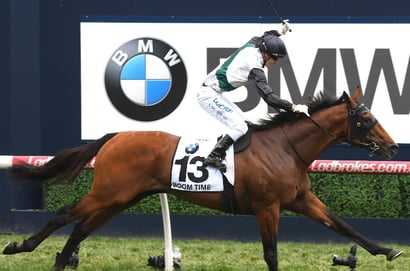
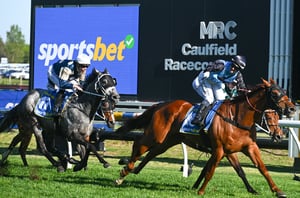
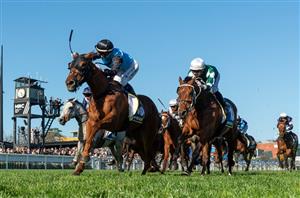
Cory Parish guides 50/1 outsider Boom Time to victory in the 2017 Caulfield Cup. (Getty)
The Caulfield Cup has produced its share of surprise results since the famous handicap was first run in 1879, with several rank outsiders defying the odds to claim one of Australian racing's most prestigious prizes.
Saturday's $6 million edition shapes as an open contest, with differing form lines and a host of genuine chances ensuring that few runners would cause a major shock should they salute.
From a 100/1 wartime winner to a controversial international triumph, we revisit five of the biggest Caulfield Cup upsets and the remarkable stories behind them.
1884 Caulfield Cup - Blink Bonny (50/1)
It didn't take long for the Caulfield Cup to produce a major upset, with Blink Bonny claiming the seventh running of the race in 1884 at odds of 50/1, having arrived from Tasmania as the outsider of the field.
Despite winning six races that season in Tasmania, Blink Bonny had disappointed in trials after joining Ballarat trainer Tommy Wilson, prompting her owner to offer her for sale before deciding to proceed with a Caulfield Cup tilt when his asking price wasn't met.
That decision proved inspired, with Blink Bonny taking the lead approaching the straight before racing clear to score by two lengths in front of a then-record crowd of more than 15,000, collecting prizemoney that had increased to two and a half times the previous year's offering.
Among those beaten was fourth-placed Malua, whose owner John Inglis had elected to ride him, with that galloper subsequently winning the Melbourne Cup to complete a remarkable Tasmanian double across the two major spring handicaps.
Blink Bonny, whose son Benedict later won the 1897 Hobart Cup, was named after the outstanding British filly who completed the Epsom Derby and Oaks double in 1857, although her Caulfield Cup triumph attracted criticism from sections of the press, with one writer questioning how such a 'weed' had managed to win.
1936 Caulfield Cup - Northwind (66/1)
Northwind was considered little more than a country-class galloper before his stunning 66/1 Caulfield Cup victory in 1936, having spent much of his career racing under Wangaratta trainer Bert Hoysted without establishing himself among the better stayers.
Bred at Northwood Park, the property now home to Godolphin's Victorian operation, Northwind caught the eye with a fast-finishing second at the former Ascot racecourse in September, prompting politician Colonel Harold Cohen to pay £1100 for the horse in pursuit of a Caulfield Cup runner.
The purchase price exceeded Northwind's career prizemoney, and his first appearance for new trainer Cecil Godby, already a dual Caulfield Cup winner, offered little encouragement when he finished second-last after racing close to the speed in the Herbert Power Stakes.
A change of tactics delivered a spectacular result before a record crowd of 63,000, with Northwind ridden quietly before storming home from the rear to claim the Cup at 66/1, having reportedly been backed at even longer odds at the Victoria Club.
Described in the press as another example of the 'glorious uncertainty of the turf', Northwind never won again and died during a gallop at Caulfield in early 1939.
1943 Caulfield Cup - Saint Warden (100/1)
Saint Warden remains the longest-priced winner in Caulfield Cup history, saluting at the extraordinary odds of 100/1 in 1943 when wartime conditions forced the famous handicap to be conducted at Flemington.
With Caulfield serving as an army barracks during World War II, the Cup was transferred to Flemington between 1940 and 1944, while a remarkable 47 final acceptors in 1943 prompted the Victorian Amateur Turf Club to divide the race into two separate contests.
The first division was won by 1941 Melbourne Cup champion Skipton, while Saint Warden claimed the other despite appearing well past his best, having previously won feature races in Adelaide and Perth before his form deteriorated.
Purchased for £300 earlier that year by trainer Jack Nicholson, who had enjoyed considerable success on the pony racing circuit, Saint Warden managed a win at Geelong but disappointed at Flemington in his final lead-up appearance.
Ridden by apprentice Harry White, Saint Warden saved ground along the rails before running down the previous year's Caulfield Cup winner Tranquil Star and drawing clear to score by three-quarters of a length, completing one of the greatest upsets in Australian racing history.
The victory was no final flash of brilliance, with Saint Warden subsequently winning the Port Adelaide Cup later in 1943 before successfully defending that title the following year.
1980 Caulfield Cup - Ming Dynasty (50/1)
Already a Caulfield Cup winner in 1977, Ming Dynasty returned three years later to produce one of the race's most memorable upsets, defying odds of 50/1 to become just the seventh horse to claim the famous handicap twice.
The popular Bart Cummings-trained grey had been in excellent form when winning as a four-year-old but was approaching the twilight of his career by 1980, although victory in that year's Australian Cup demonstrated that the seven-year-old still possessed considerable ability.
Much of the attention centred on the anticipated clash between two outstanding gallopers, Kingston Town and Hyperno, who both performed admirably to finish in the placings but were unable to withstand Ming Dynasty's powerful finishing burst.
Despite covering additional ground, Ming Dynasty swept clear to win by a length and a quarter, prompting one newspaper to celebrate the veteran with the headline 'Old Ming - a beauty', while describing him as galloping with the enthusiasm of a four-year-old.
Following his retirement, Ming Dynasty enjoyed a second career as a Clerk of the Course horse before dying at the age of 28 in May 2002, with his contribution to Australian racing recognised through the Group 3 Ming Dynasty Quality at Randwick.
Two further 50/1 outsiders have since joined the Caulfield Cup honour roll, with Imposera winning in 1988 and Boom Time causing another upset in 2017.
1998 Caulfield Cup - Taufan's Melody (66/1)
Taufan's Melody created history in the 1998 Caulfield Cup, becoming the first overseas-trained winner and the first prepared by a female trainer, although his remarkable 66/1 triumph remains among the most controversial finishes in the race's history.
New Zealand-bred Maranui had become the first winner bred outside Australia in 1908, while British-bred Shepherd King followed in 1916 despite entering the race as a six-year-old maiden, but it was another 82 years before a northern hemisphere-trained runner claimed the prize.
Prepared in England by Lady Herries, Taufan's Melody had gained a place in the field at the discretion of the committee and was already in front early in the straight when the challengers began to close.
Under pressure, the gelding shifted sharply towards the inside rail, causing severe interference to Jezabeel and Champagne, who would subsequently quinella the Melbourne Cup, with Jezabeel's jockey Chris Munce describing the incident as among the worst interference he had witnessed in a Group 1 race.
Taufan's Melody survived the resulting protest, although winning jockey Ray Cochrane was fined $20,000 and suspended for one month, ensuring the historic international victory remained the subject of considerable debate.
A well-travelled galloper, Taufan's Melody also won stakes races in France, Germany and England during his career, while Lady Herries enjoyed further international success with Celtic Swing, who later became the sire of Australian sprinting champion Takeover Target.
Betting offers
Upcoming Events
15 October 2026
- Northam - October 15 -
- Horse Racing
- Brisbane Bullets vs South East Melbourne Phoenix -
- Basketball
- Australia vs New Zealand -
- Rugby League
- Alexander Zverev vs Alex De Minaur -
- Tennis
- Pathum United vs Adelaide United -
- Soccer
16 October 2026
- Taree - October 16 -
- Horse Racing
- Samoa vs France -
- Rugby League
- Tasmania JackJumpers vs Adelaide 36ers -
- Basketball
- Sydney FC v Western Sydney Wanderers -
- Soccer
17 October 2026
- The Everest -
- Horse Racing
- Caulfield Cup -
- Horse Racing
- Thousand Guineas -
- Horse Racing
- Auckland FC v Melbourne City -
- Soccer
- Papua New Guinea vs Lebanon -
- Rugby League
- King Charles III Stakes -
- Horse Racing
- Macarthur FC v Perth Glory -
- Soccer
- England vs Tonga -
- Rugby League
Load More