State of Origin Eligibility Explained (2026 Rules)

The 2026 State of Origin eligibility rules have been updated to separate international representation from Origin selection. Players can now represent nations like New Zealand, Tonga, or England internationally and still be eligible for State of Origin if they fulfill specific criteria related to their development ties with New South Wales or Queensland. Key criteria include birthplace, residency before the age of 13, or having a parent who played State of Origin. These updates accommodate the global growth of rugby league and maintain the spirit of the competition.
- 2026 updates separate international representation from Origin eligibility.
- Eligibility for NSW or QLD is based on birthplace, residency before age 13, or parental history in State of Origin.
- Players can now represent any nation internationally without affecting their State of Origin eligibility.
-19024125.jpg/w=410)
State of Origin Eligibility Explained (2026 Rules updated)
The Core Eligibility Criteria
- Be born in NSW or QLD, OR
- Have resided in NSW or QLD before their 13th birthday, OR
- Have a parent who played State of Origin
- Junior club football (Under 6–18)
- Schooling
- Junior representative pathways
- Residential history
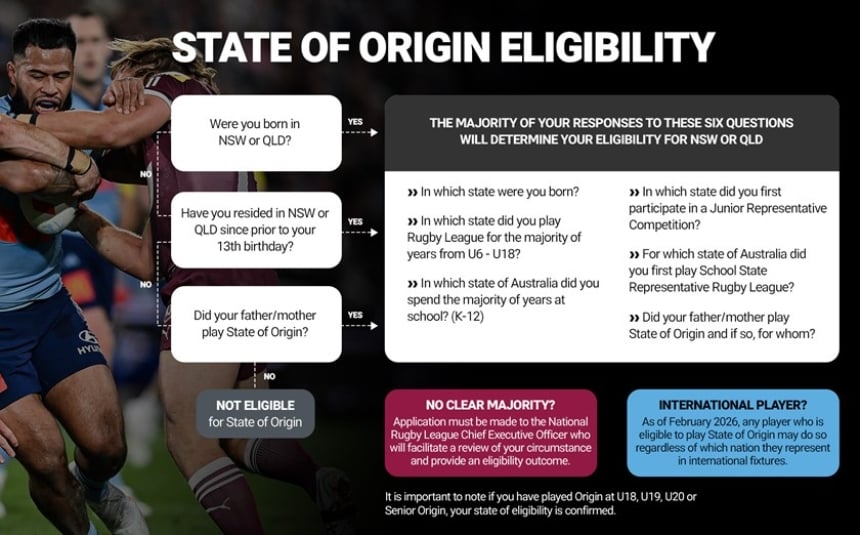
Does International Representation Affect Origin Eligibility?
Has the System Changed?
Important Note: Eligibility Lock-In
State of Origin Eligibility FAQ's
Can you play State of Origin if you represent New Zealand, England, Tonga or Samoa?
Yes. Under the 2026 eligibility update, players can represent another nation and still play State of Origin, provided they meet NSW or Queensland eligibility criteria. International representation no longer affects Origin eligibility.
Does birthplace automatically decide Origin eligibility?
Not always. Birthplace is one factor, but the NRL also considers where a player lived and played junior rugby league before age 13. Development history can outweigh birthplace in some cases.
Can a player switch Origin states?
No. Once a player represents a state at Under 18, Under 19, Under 20 or Senior Origin level, their eligibility is locked in.
Why were the Origin eligibility rules changed in 2026?
The Australian Rugby League Commission modernised the rules to reflect the growth of the international game.
The update allows players to represent any nation internationally while still playing Origin, strengthening both the State of Origin series and global rugby league.
Top Betting Sites
Betting offers
Upcoming Events
06 October 2026
- Mildura - October 6 -
- Horse Racing
- Newcastle - October 6 -
- Horse Racing
- Goulburn - October 6 -
- Horse Racing
- Newcastle Top Picks Combo -
- Horse Racing
- Carlos Alcaraz vs Jiri Lehecka -
- Tennis
- Alex de Minaur vs Novak Djokovic -
- Tennis
- Croatia v Spain -
- Soccer
- England vs Czech Republic -
- Soccer
07 October 2026
- Adelaide 36ers vs Melbourne United -
- Basketball
10 October 2026
- Toorak Handicap -
- Horse Racing
- Might And Power Stakes -
- Horse Racing
- Caulfield Guineas -
- Horse Racing