AFL Hamstring Injury Crisis 2026: What’s Causing the Spike?

The 2026 AFL season is witnessing a surge in hamstring injuries, affecting top players. This rise isn’t due to bad luck but the intensifying speed requirements demanded by modern gameplay. Players are pushed to run faster rather than farther, causing frequent injuries, especially under fatigue. This trend also affects star players, leading to strategic rotations and a focus on minimizing game time for optimal impact. As the game gets faster, the key question is whether players can sustain this pace, forcing clubs to weigh performance against player durability.
- AFL faces a hamstring injury rise due to intensified speed demands.
- Star players affected; clubs adapt by managing game time strategically.
- Injury trends may impact teams' depth, finals spots, and season outcomes.
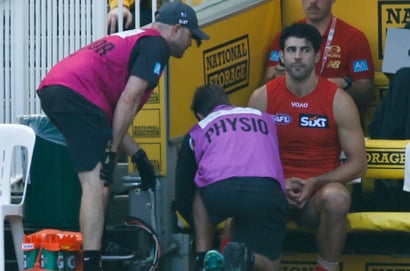
AFL Hamstring Injury Crisis (Photo by Michael Willson/AFL Photos via Getty Images)
AFL Hamstring Injury Crisis 2026: What’s Really Going On?
The 2026 AFL season has barely started, and already there’s a clear trend emerging that hamstring injuries are everywhere.
- AFL Hamstring Injury Crisis 2026: What’s Really Going On?
- Why Are Hamstring Injuries Increasing in the AFL?
- The Star Power Problem: Why Big Names Are Getting Hit
- Is the Modern AFL Game Too Demanding?
- Tactical Shift: Are We Entering the “Impact Player” Era?
- What It Means for the 2026 AFL Season
- The Bigger Picture
Not just fringe players either. Some of the competition’s biggest names are going down, and it’s forcing clubs to rethink how the modern game is played.
This isn’t bad luck. It’s something deeper.
Why Are Hamstring Injuries Increasing in the AFL?
The biggest shift isn’t how far players are running, it’s how fast they’re running.
Clubs are now prioritising high-speed efforts over total kilometres. Training sessions are shorter, but far more intense, with a focus on repeat sprint work and explosive movement.
That’s great for performance. But it comes with a cost.
When players are repeatedly hitting top speeds, especially late in games when fatigue kicks in, the hamstrings are under constant strain. That’s where injuries start to appear.
And once one goes, it’s rarely isolated.
The Star Power Problem: Why Big Names Are Getting Hit
What makes this trend more concerning is who it’s impacting.
We’re not just seeing depth players sidelined it’s elite, high-impact midfielders and forwards. The types of players who rely most on burst, acceleration and repeat sprint efforts.
Think players in the mould of:
- Christian Petracca
- Isaac Heeney
- Connor Rozee
- Hayden Young
These are explosive, game-breaking players. And they’re the exact profile most exposed to this shift in physical demand.
When they go down, it doesn’t just hurt teams, it changes games, rounds, and even betting markets.
Is the Modern AFL Game Too Demanding?
There’s a growing sense that the game has reached a new physical threshold.
Players may be spending slightly less time on the ground, but the intensity of those minutes has skyrocketed. Every contest, every transition, every defensive sprint is being played at a higher speed than ever before.
That raises a serious question:
Are all players actually built to handle this version of the game?
Those with previous soft tissue issues are particularly vulnerable. Once fatigue meets high-speed demand, the margin for error disappears.
Tactical Shift: Are We Entering the “Impact Player” Era?
One flow-on effect is already starting to emerge, player management during games is changing.
Instead of loading stars with heavy minutes, clubs are beginning to use them in shorter, sharper bursts. Maximum impact, less exposure.
It’s not officially the return of the sub rule, but functionally, it’s getting close.
Rotations are more flexible. Players are coming on and off more frequently. And time-on-ground is becoming a tactical weapon rather than a fitness test.
What It Means for the 2026 AFL Season
If this trend continues, it could shape the entire season.
- Teams with better depth will have a clear advantage
- Injury management could decide finals spots
- Star availability may fluctuate week-to-week
And most importantly, clubs may need to rethink the balance between performance and durability.
Because right now, the game is getting faster.
But bodies aren’t necessarily keeping up.
The Bigger Picture
The AFL has always evolved tactically, structurally, physically. But this feels like a tipping point.
The speed of the modern game is pushing players to their limits. And until there’s an adjustment, whether in training, rotations, or game style the hamstring injury crisis might just be the new normal.
Related



Top Betting Sites
Betting offers
Upcoming Events
03 October 2026
- Eagle Farm- October 3 -
- Horse Racing
- Randwick- October 3 -
- Horse Racing
- Flemington- October 3 -
- Horse Racing
- Murray Bridge - October 3 -
- Horse Racing
- Saturday Roughies - October 3 -
- Horse Racing
- Flight Stakes -
- Horse Racing
- Turnbull Stakes -
- Horse Racing
- Epsom Handicap -
- Horse Racing
- Kalgoorlie - October 3 -
- Horse Racing
- The Metropolitan Super Dabble -
- Horse Racing
- Brisbane Bullets vs Tasmania JackJumpers -
- Basketball
- Melbourne United vs Cairns Taipans -
- Basketball
- Warrington Wolves vs Wakefield Trinity Super League Grand Final -
- Rugby League
04 October 2026
- NRL 2026 Grand Final -
- Rugby League
- 2026 Clive Churchill Medal Betting Tips - Walker & Ponga Favourites for a Reason
- 2026 NRL Grand Final First Try Scorer Tips & Predictions - Sydney Roosters vs Newcastle Knights
- Sydney Roosters vs Newcastle Knights NRL Grand Final 2026 Tips - Knights To Keep It Close
- NRL Grand Final Betting Specials - Best Promos for Roosters vs Knights
- Roosters vs Knights NRL Predictions - Threading the needle with some long odds Grand Final SGMs backed by stats
- NRL Grand Final Same Game Multi Predictions - 35+ betting stats & player prop trends to build your SGM with CrownBet
- NRL Grand Final Team Lists 2026: Roosters vs Knights Teams
- 2026 NRL Grand Final Sydney Roosters vs Newcastle Knights Early Predictions
- 2026 NRL Premiership Winner Odds - Weekly Blogg & Updated Markets
10 October 2026
- Toorak Handicap -
- Horse Racing
- Might And Power Stakes -
- Horse Racing
- Caulfield Guineas -
- Horse Racing
Load More