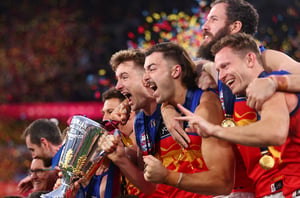
Has the AFL Become a Two-Tier Competition in 2026?

The 2026 AFL season presents concerns about a growing disparity between teams, suggesting a potential shift towards a two-tier competition. Top teams showcase ruthless efficiency, capitalizing on their systems' strengths, while rebuilding teams struggle to keep pace. The structural gap, accentuated by draft challenges and player movement, highlights the risk involved in rebuilding strategies. As stronger teams continuously improve, weaker teams face prolonged catch-up periods, potentially solidifying the league’s split into two distinct tiers. This evolving dynamic challenges the league to address the emerging imbalance.
- AFL 2026 shows signs of a two-tier split with dominant teams overpowering others.
- Structural challenges in team rebuilding make the gap appear permanent.
- The league faces the challenge of addressing and balancing this growing disparity.
True Footy AFL Podcast
Has the AFL Become a Two-Tier Competition in 2026?
There’s something about the 2026 AFL season that feels off. Not broken. Not unwatchable. But different in a way that’s becoming harder to ignore with each passing round.
- Has the AFL Become a Two-Tier Competition in 2026?
- The Blowouts Aren’t Flukes Anymore
- The Gap Is Structural, Not Temporary
- Rebuilds Are Starting to Look Riskier Than Ever
- This Is What a Two-Tier Competition Looks Like
- The Season Will Answer the Question
Because right now, it doesn’t feel like one competition.
It feels like two.
At one end, there are teams that can flick a switch and blow games apart in the space of 20 minutes. At the other, there are sides that can compete for patches, maybe even a half, but inevitably get overrun when the pressure lifts.
That gap has always existed in some form. But the way it’s showing up this season feels more extreme, more consistent, and more revealing.
And it’s starting to raise an uncomfortable question about where the AFL is heading.
The Blowouts Aren’t Flukes Anymore
A single big margin can be explained away. Two or three can be written off as early-season rust.
But when it becomes a weekly pattern, it starts to mean something.
The best teams aren’t just winning. They’re dismantling sides. Once they get control, they don’t ease off. They accelerate. They sense vulnerability and lean into it, turning competitive games into non-events before three-quarter time.
Sydney’s destruction of West Coast wasn’t just a bad day for one side. It was a glimpse into how ruthless the top tier has become. The Bulldogs have shown the same capacity. Gold Coast, when they get their game going, look just as capable.
This is no longer about talent alone. It’s about systems that are so well-drilled, so efficient, that once they gain territory, they convert it relentlessly.
And the teams at the bottom simply don’t have the tools to respond.
The Gap Is Structural, Not Temporary
What makes this more concerning is that the gap doesn’t feel accidental.
It feels built in.
The modern AFL game rewards speed, precision and decision-making under pressure more than ever. If a team can move the ball cleanly and hit targets, the reward is immediate. Scores come quickly. Momentum compounds. Confidence builds.
But if a team can’t execute at that level, the punishment is just as immediate.
That’s where rebuilding sides are getting caught.
It’s not just that they’re younger. It’s that their entire system is still forming. Their connection isn’t quite there. Their decision-making breaks down under pressure. And against elite teams, that gets exposed brutally.
You can see it happen in real time. A missed kick. A turnover. A quick transition the other way. Goal. Centre bounce. Repeat.
Before long, the game is gone.
Rebuilds Are Starting to Look Riskier Than Ever
For years, bottoming out was seen as a necessary step. Strip the list, accumulate picks, build from the ground up.
That model now looks far less reliable.
The pathway back up the ladder is no longer straightforward. Drafting well is harder. Player movement is more aggressive. And young talent isn’t guaranteed to stay long enough to see the rebuild through.
At the same time, the teams at the top aren’t standing still. They’re refining, optimising, and building depth that allows them to absorb injuries and maintain performance.
That creates a dangerous imbalance.
The good teams keep getting better. The struggling teams take longer to catch up.
And when they meet, the difference is obvious.
This Is What a Two-Tier Competition Looks Like
No one will officially say it, but this is what a split competition looks like.
There is a group of teams playing fast, clean, high-efficiency football that stands up every week. Then there is a group trying to stay competitive while still figuring out who they are.
The ladder might not show a clean divide yet, but the performances do.
And once that gap becomes normalised, it becomes harder to close.
Because belief shifts with it.
The top teams expect to win. The bottom teams hope to compete.
That’s a very different mindset.
The Season Will Answer the Question
There is still time for things to change.
Injuries will hit. Form will fluctuate. Some of those bottom teams will improve as the season goes on.
But the early signs are telling.
If this pattern holds, the conversation will shift from whether the AFL is becoming a two-tier competition to whether it already is one.
And that’s when the league has a bigger question to answer.
Not about rules. Not about fixtures.
But about balance.
Because right now, the gap doesn’t just feel real.
It feels like it’s growing.
Related


Top Betting Sites
Betting offers
Upcoming Events
03 October 2026
- Eagle Farm- October 3 -
- Horse Racing
- Randwick- October 3 -
- Horse Racing
- Flemington- October 3 -
- Horse Racing
- Murray Bridge - October 3 -
- Horse Racing
- Saturday Roughies - October 3 -
- Horse Racing
- Flight Stakes -
- Horse Racing
- Turnbull Stakes -
- Horse Racing
- Epsom Handicap -
- Horse Racing
- Kalgoorlie - October 3 -
- Horse Racing
- The Metropolitan Super Dabble -
- Horse Racing
- Brisbane Bullets vs Tasmania JackJumpers -
- Basketball
- Melbourne United vs Cairns Taipans -
- Basketball
- Warrington Wolves vs Wakefield Trinity Super League Grand Final -
- Rugby League
04 October 2026
- NRL 2026 Grand Final -
- Rugby League
- 2026 Clive Churchill Medal Betting Tips - Walker & Ponga Favourites for a Reason
- 2026 NRL Grand Final First Try Scorer Tips & Predictions - Sydney Roosters vs Newcastle Knights
- Sydney Roosters vs Newcastle Knights NRL Grand Final 2026 Tips - Knights To Keep It Close
- NRL Grand Final Betting Specials - Best Promos for Roosters vs Knights
- Roosters vs Knights NRL Predictions - Threading the needle with some long odds Grand Final SGMs backed by stats
- NRL Grand Final Same Game Multi Predictions - 35+ betting stats & player prop trends to build your SGM with CrownBet
- NRL Grand Final Team Lists 2026: Roosters vs Knights Teams
- 2026 NRL Grand Final Sydney Roosters vs Newcastle Knights Early Predictions
- 2026 NRL Premiership Winner Odds - Weekly Blogg & Updated Markets
10 October 2026
- Toorak Handicap -
- Horse Racing
- Might And Power Stakes -
- Horse Racing
- Caulfield Guineas -
- Horse Racing
Load More