Beyond The Enhanced Games: Have humans already broken the limits of what's possible?

The first edition of the enhanced games is set to take place in Las Vegas, sparking debate over the role of doping, technology, and genetics in sports. Critics argue the competition could compromise health and fair play, but supporters see commercial benefits and a chance to test human limits. Historical athletic achievements, like Kipchoge's marathon run, highlight existing genetic advantages. This raises the question: should modern sports embrace enhancements, or should restrictions remain to uphold a level playing field?
- Enhanced Games debut in Las Vegas, raising debates on doping and technology.
- Supporters highlight commercial potential and testing human limits.
- Historical context from athletes like Usain Bolt and Eliud Kipchoge.
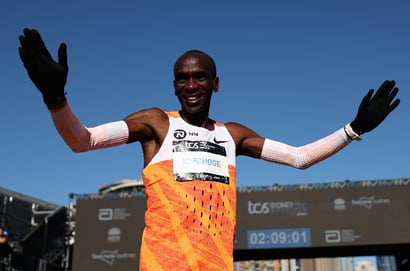
Eliud Kipchoge of Kenya thanks spectators following the 2025 Sydney Marathon on August 31, 2025 in Sydney, Australia. (Photo by Cameron Spencer/Getty Images)
On the 24th of May this year, in Las Vegas, or more appropriately known as Sin City, history will be made as the first, and potentially only, edition of The Enhanced Games is set to take place.
Aron D’Souza’s idea has met obvious opposition due to the health concerns and destruction of moral fairplay within sport. So why are there still supporters?
The commercial opportunities of the event are huge. The potential of an all-access documentary would be something very typical of Netflix, based on the success of their recent sporting documentaries like “Drive to Survive" and “Full Swing”.
The other idea is to push the human body to see what is really possible. How fast can someone run? How far can someone throw? How heavy can someone lift?
Doping is banned due to providing an unfair advantage to the athletes who choose to dope. But does technology and genetics provide some athletes with an unfair advantage already, and does doping always mean you will perform better?
The myth that a human cannot run a mile in under 4 minutes was the first to fall. Englishman Roger Bannister banished the concept by running a 3 minute 59 mile all the way back in 1954. Since then, many people have broken the 4-minute mark, with Moroccan middle-distance runner, Hicham el Guerrouj holding the world record with a time of 3:43.13, just a split second ahead of Norwegian middle-distance powerhouse Jakob Ingebrigtsen.
The men's 100m Olympic final is the pinnacle of De Coubertin's creation in the modern Olympic Games. Lights, camera, action, and a hundred million pairs of eyes tuned in for 10 seconds.
According to Madeline Kelly writing for the Canadian Running Magazine back in 2020, "Of the 10 best 100m sprinters in history, only three have never had a doping charge". 1 of them, the world record holder and debatably the greatest Olympian of all time, Usain Bolt. Despite the doping efforts of his rivals Tyson Gay, Justin Gatlin, and Yohan Blake, none of them were able to run 100m faster than the man whose body "wasn't made for sprinting”.
Both of these examples so far showcase how some athletes are genetically superior to others. Now, does that mean that this athlete has an unfair advantage because they have a higher VO2 Max or longer limbs than another? Maybe, but isn't that just sport?
The greatest physical achievement in recent times was in Vienna on the 12th of October 2019, when the greatest marathon runner of all time, Eliud Kipchoge, ran 26.2 miles in under 2 hours. As he crossed the finish line, he broke the reality of what is humanly possible.
So why does his fellow countryman, Kevin Kiptum, hold the world record with 2 hours and 35 seconds rather than Kipchoge's 1 hours 59 minutes and 40 seconds?
Kipchoge wasn't in a race. It's that simple.
Ineos set up the challenge for Kipchoge with everything perfect. Vienna was chosen for the location as one of the fastest marathon routes in the world. The shoes Eliud wore were banned previously due to giving runners an unfair advantage with an 85% energy return due to the carbon plate and thick sole.
He had pro runners pacing his 4:34 per mile splits, indicated by a car in front of him who shielded him from the wind.
The nutrients and when he took them throughout the race were calculated perfectly to the milliliter to ensure maximum physical performance. All of this meant that it wasn't a valid world record.
But Kipchoge still ran 26.2 miles without any enhanced drugs faster than anyone in history.
Overall, these examples are extreme, but if sport technology begins to be restricted due to providing an unfair advantage, should every marathon be run barefoot?
What about if genetically, some legs are longer and BMI is lower than their opponent, meaning they have an unfair advantage over their opponent?
Some people are naturally more suited to certain sports, so is sport always destined to be unfair, or is the solution allowing no boundaries to push performance, including doping, technology, and whatever someone is willing to do to win?

Top Betting Sites
Betting offers
Upcoming Events
19 October 2026
- Lorenzo Musetti vs Matteo Arnaldi -
- Tennis
- Tottenham v Coventry -
- Soccer
20 October 2026
- Grafton - October 20 -
- Horse Racing
- Kyneton- October 20 -
- Horse Racing
21 October 2026
- Tasmania JackJumpers vs Brisbane Bullets -
- Basketball
Load More