Has The NRL Become A Victim Of Its Own Success?

The NRL's rapid growth has resulted in more games and expanded coverage, catering to fans' long-standing demand for more rugby league. Yet this success has created a new challenge—an oversupply of content that even ardent supporters struggle to keep up with, often at the expense of the NRLW's visibility. The article argues that while growth is a positive development, the league must now focus on ensuring fans can continue to engage meaningfully. The key takeaway: balancing content volume with audience capacity is crucial as the game’s popularity rises.
- NRL's growth has led to an overwhelming amount of content for fans.
- Even dedicated followers find it hard to keep up, impacting NRLW viewership.
- Key challenge: Balance expansion with fans' capacity to stay engaged.
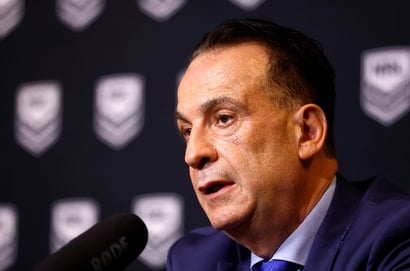
ARLC Chair Peter V’landys. (Photo by Darrian Traynor/Getty Images)
Has The NRL Become A Victim Of Its Own Success?
There was a time when rugby league fans wanted one thing above all else - more footy.
More games on free-to-air television. More content during the week. More reasons to stay engaged outside the 80 minutes on a Friday or Saturday night.
Over the past decade, the NRL has delivered exactly that. The competition has expanded, broadcast windows have grown, the NRLW continues to build momentum and rugby league now dominates more of the sporting calendar than ever before.
That's unquestionably been good for the game but after another marathon weekend of football, we found ourselves asking a question on the latest League of Inches podcast that probably would have sounded ridiculous a few years ago.
Has the NRL reached the point where there's simply too much rugby league for fans to keep up with?
Even The Biggest Rugby League Fans Are Feeling It
This isn't coming from someone who casually follows the game. My job revolves around watching rugby league. Between preparing for podcasts, writing articles, keeping up with team news and following the betting markets, I'm watching more football than most people ever will.
Even then, there are weekends where it starts to feel like you're chasing the competition rather than enjoying it.
Three games on a Sunday sounds fantastic in theory, but by the time the final match kicks off you've already invested two full days into the sport. That's before you've listened to analysis, watched press conferences or caught up on everything you inevitably missed while another game was being played.
If people who live and breathe rugby league are beginning to feel that way, it's worth asking how the average fan is supposed to consume it all.
More Content Doesn't Always Mean More Engagement
The NRL has every reason to keep growing. More games create more broadcast inventory and more broadcast inventory creates more revenue, that's how modern professional sport works.
The challenge is that attention doesn't grow at the same rate. Fans still have jobs, families and commitments outside rugby league, they don't suddenly find another six or eight hours every weekend because another game has been added to the schedule.
At some point, every sport reaches a tipping point where adding more content doesn't necessarily create more engagement. Instead, people begin picking and choosing what they watch, and inevitably something starts getting left behind.
That's not a criticism of the game, it's simply the reality of how people consume sport.
The NRLW Deserves Better Than Being Squeezed In
The part of the discussion that really stood out to me wasn't actually about the NRL, it was about the NRLW.
I'm someone who genuinely enjoys the women's competition and usually makes a point of watching several games each week. This season I've barely seen any of it and not because the quality has dropped or that i've lost interest.
Simply because by the time the NRL weekend finishes, I've already spent so many hours watching rugby league that I don't have the capacity to keep going.
That worries me because I'm exactly the audience the NRLW should be capturing. If someone like me is struggling to find the time, there's a good chance plenty of other fans are making the same choice. That's not a reflection on the product. It's a reflection on the schedule.
The women's game deserves the opportunity to build its own audience, and that becomes much harder if it's constantly competing for attention with an already overloaded rugby league calendar.
Growth Is A Good Problem To Have
None of this is an argument for cutting games or slowing the growth of the sport. The NRL is in one of the healthiest positions it's been in for years and there are far worse problems to have than people wanting to consume your product.
What it does suggest is that the next challenge for the game isn't simply creating more content. It's making sure fans still have the time and energy to enjoy it. The best competitions leave supporters wanting more when the weekend finishes.
That's the balance the NRL has to protect as it continues to grow. Because while more rugby league has been fantastic for the game, there comes a point where even the most passionate fans can only watch so much.
Top Betting Sites
Betting offers
Upcoming Events
31 August 2026
10 September 2026
- NFL 26/27 Week 1 -
- NFL
- Seymour - September 10 -
- Horse Racing
- Hawkesbury - September 10 -
- Horse Racing
- Hawkesbury Double Chance -
- Horse Racing
- Bunbury - September 10 -
- Horse Racing
- Aryna Sabalenka vs Jessica Pegula -
- Tennis
- Fenerbahce v Roma -
- Soccer
- Manchester United vs Sabah -
- Soccer
11 September 2026
- Elena Rybakina vs Coco Gauff -
- Tennis
- Geelong- September 11 -
- Horse Racing
- Goulburn - September 11 -
- Horse Racing
- Sunshine Coast - September 11 -
- Horse Racing
- South Sydney Rabbitohs vs Newcastle Knights -
- Rugby League
- Fremantle Dockers vs Geelong -
- AFL
Load More